noedit / 6.21.26 / banville and the seed of failure
Well I don’t quite know why but I’ve started reading The Untouchable by John Banville and it’s made me come here to my computer on Father’s Day morning to do what I enjoy.
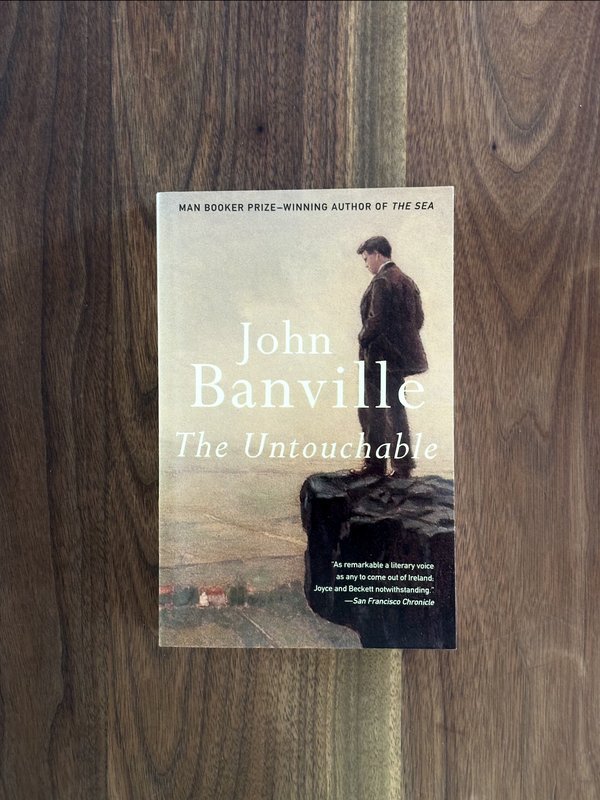
So at first that might be a compliment of sorts. An inspiration.
But there’s something about Banville’s writing that makes me both ashamed and proud of my own. He is clearly an extremely intelligent man. Another compliment, of sorts, except I’m wondering if his intelligence leans toward cleverness, that sometimes irresistible urge as a writer to prove to everyone, once and for all, how smart you really are. Or is it just jealousy talking? Banville’s prose is so complex, so networked and varied, with an organic unfolding and such realism to time and place that I’ve got to stand back and say wow. Wow then.
And because this is my first Banville novel I should probably refrain from conclusions but I get the creeping feeling that Banville thinks he is much smarter than everyone else, and so do his characters. Now this would not be a problem if it were one character, but in The Untouchable, most of them give off a kind of prickly superiority, and dare I say insouciance that feels like it’s radiating from beneath the page. Beneath the page is the best I can put it.
Of course I can’t help myself so I looked up Banville and found that he is a fan of Nabokov, and that was no surprise because both appear to be crafted from the same hyperintelligent cloth that somehow lets the generosity seep right out of them, and into the ground. Like Nabokov more than a few of Banville’s quotes are takedowns of other writers, including Nabokov (flawed because he was tone deaf, according to Banville), but also Dostoyevsky, who was, everything according to Banville now, “such a bad writer it is hard to take him seriously.” Okay then. Dostoyevsky? Keep in mind Banville did not go to university, and he claims for the better, but with The Untouchable centering on the Oxbridge crowd, and Banville so busy cutting down every intellectual within pen’s reach, one has to wonder if he’s got a bit of a chip on his old shoulder about it. That he’s trying to prove something to everyone.
Aren’t we all? I would say probably, being social animals, we are. And I feel it myself, hopefully less and less with time, this desire for people to be impressed with me, by me, or my books, which may serve as proof of my own capacity, or worth. Banville threatens that, clearly, since I could never write as technically well as he can. Fortunately, I tell myself, consolingly, taking my ego into a warm and gentle embrace, that’s not the point, if there is a point at all.
I am reminded instead of my favorite book on writing which is not a book on writing at all: Zen Mind, Beginner’s Mind by Shunryu Suzuki Roshi. Except of course it is a book on writing. I would argue it is the best writing book I have ever read, and so I have read it more than fifty times, at least, all the way through, and probably a hundred if you glue together all the random looks. Suzuki offers endless, often cryptic advice on Zen practice, but one can easily substitute writing practice or bicycling practice or parenting practice or whatever else you’d like. He is operating at the very foundation of things, instead of, say, at the sentence-level, or in terms of character, or whatever other superstratum you’d like to restrict yourself to. And among many brilliant insights, he suggests that practice committed in the hope of achieving something else (e.g., writing to impress someone) begins from a seed of failure.
We cannot write with some ulterior motive in mind, or else that will seep up from the ground, immediately or suddenly or eventually or even just in a strange sort of smell, that will become noticeable to the readers, telling us not about the purest part of a writer’s soul, if I can dare to be so romantic, but about a writer’s ego. And while a writer’s ego may impress with big words and fancy constructions and endless elaborations, it will never satisfy. Not the reader, and more importantly, not the writer. So our best hope then, as writers (or whatever your practice) is to become as true to your own impulse as possible, to, like a Zen student, seek your own true nature, your own true style and structure, which, fortunately, will come through, if only you are quiet and patient and gentle enough to let it rise.